From Burnout to Coconut Charcoal – How sustainable charcoal made from coconut shells & bamboo came to be
The coconut as a raw material for high-quality BBQ briquettes
Kasper Damkier, the founder of McBrikett, discovered the coconut and the potential of its hitherto almost unused shell on a journey around the world. More energy than wood, and no trees need to be cut down to access that energy.
After 13 months of traveling and with recharged batteries, he set to work on his new project: to offer the world's grillers a better alternative to charcoal. Higher quality and environmentally friendly, as no forest has to die.
At the age of 29, I embarked on an uncertain journey. I was burned out from my last job as a self-employed event manager and took the brave step of flying to New Zealand with a one-way ticket to see what life still had in store for me.
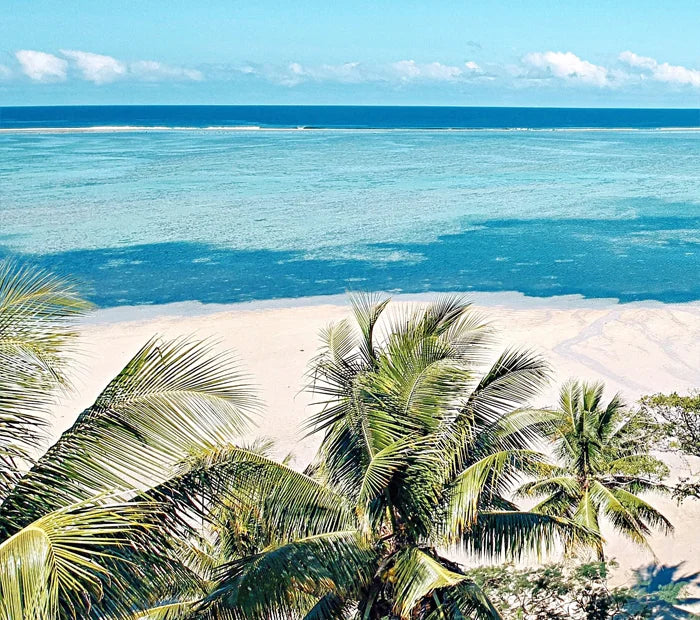
After 9 months in a self-built camper van and much refreshing nature in New Zealand, I landed on the Fiji Islands. A planned 2-week trip turned into almost half a year on Vanua Levu, Fiji's second largest island.
Here I got to know the coconut, because it was burned unused by the locals after they removed the coconut meat (copra). They had no use for the shells. That's when the seed of an idea was planted in my head; I wanted to do something with coconuts, but I didn't know what yet.
The idea of making charcoal from raw husks came from a friend with whom I was discussing the possibilities in Fiji.
He told me about bamboo charcoal, which is used for grilling in China, and how incredibly hot and long it glows.
From bamboo charcoal, through research, I quickly discovered coconut charcoal and was soon convinced by the idea.
Coconut shells are a byproduct of coconut oil and coconut milk production, and at the same time, they are true powerhouses.
Compared to significantly less energy-efficient wood charcoal, coconut charcoal and bamboo charcoal are made from a byproduct of the processing industry, and are essentially waste.
At the age of 29, I embarked on an uncertain journey. I was burned out from my last job as a self-employed event manager and took the brave step of flying to New Zealand with a one-way ticket to see what life still had in store for me.
After 9 months in a self-built camper van and much refreshing nature in New Zealand, I landed on the Fiji Islands. A planned 2-week trip turned into almost half a year on Vanua Levu, Fiji's second largest island.
Here I got to know the coconut, because it was burned unused by the locals after they removed the coconut meat (copra). They had no use for the shells. That's when the seed of an idea was planted in my head; I wanted to do something with coconuts, but I didn't know what yet.
The idea of making charcoal from raw husks came from a friend with whom I was discussing the possibilities in Fiji.
He told me about bamboo charcoal, which is used for grilling in China, and how incredibly hot and long it glows.
From bamboo charcoal, through research, I quickly discovered coconut charcoal and was soon convinced by the idea.
Coconut shells are a byproduct of coconut oil and coconut milk production, and at the same time, they are true powerhouses.
Compared to significantly less energy-efficient wood charcoal, coconut charcoal and bamboo charcoal are made from a byproduct of the processing industry, and are essentially waste.
"It's a name that's very easy to remember, it brings a positive smile to people's faces, and they always pause to think about the name when they hear it."
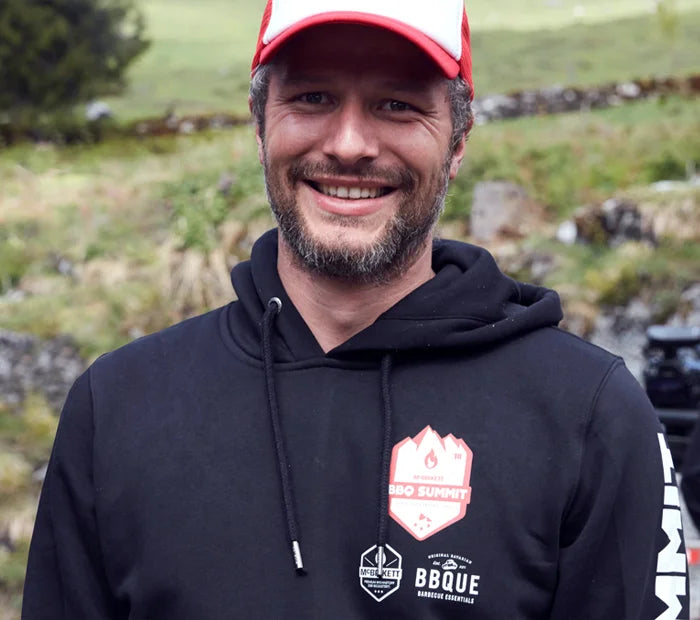
Before I got the tip about bamboo charcoal, which led me to coconut charcoal, I had the idea with a friend to sell wood briquettes for heating. We wanted to call the company "McBrikett." However, we never implemented it. When I was working on the coconut charcoal project, I still needed a name, and my buddy fortunately didn't mind me wanting to use our name for my new project. Because I simply liked the name.
I had no doubts that one's products would be branded as cheap by the prefix "Mc." When the first few years turned out to be more difficult than expected, I briefly doubted whether the name was right for high-quality premium products, but I don't regret it to this day.
Because the name is still easy for everyone to remember, provides good recognition, and almost always elicits a smile when they hear the name for the first time.
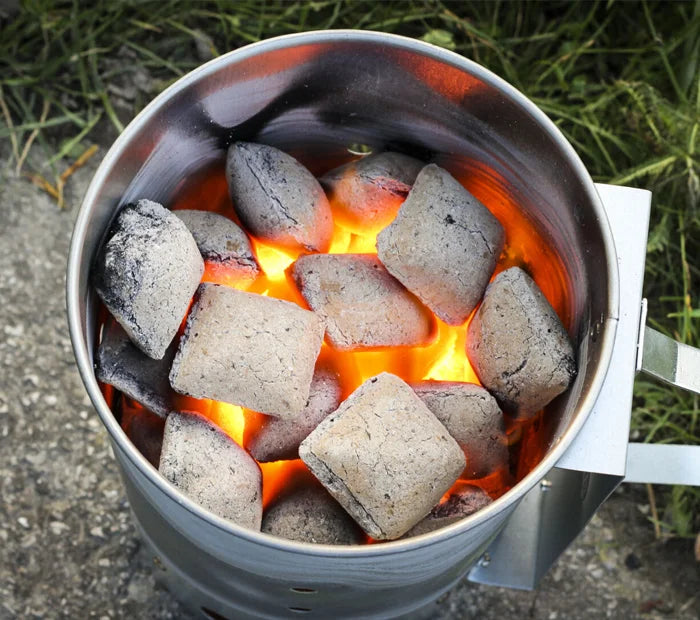
Ten years have passed since then, and McBrikett has established itself as the top address for sustainable, premium BBQ charcoal, supplying all who refuse to compromise on quality. Among others, all European BBQ champions have been grilling with McBrikett coconut charcoal since its founding in 2013.
We have continuously developed our products. Our range includes two high-quality charcoals, MARABU and BIG WATTLE, both sourced sustainably. Here too, waste is refined into very high-quality charcoal.
Before I got the tip about bamboo charcoal, which led me to coconut charcoal, I had the idea with a friend to sell wood briquettes for heating. We wanted to call the company "McBrikett." However, we never implemented it. When I was working on the coconut charcoal project, I still needed a name, and my buddy fortunately didn't mind me wanting to use our name for my new project. Because I simply liked the name.
I had no doubts that one's products would be branded as cheap by the prefix "Mc." When the first few years turned out to be more difficult than expected, I briefly doubted whether the name was right for high-quality premium products, but I don't regret it to this day.
Because the name is still easy for everyone to remember, provides good recognition, and almost always elicits a smile when they hear the name for the first time.
Ten years have passed since then, and McBrikett has established itself as the top address for sustainable, premium BBQ charcoal, supplying all who refuse to compromise on quality. Among others, all European BBQ champions have been grilling with McBrikett coconut charcoal since its founding in 2013.
We have continuously developed our products. Our range includes two high-quality charcoals, MARABU and BIG WATTLE, both sourced sustainably. Here too, waste is refined into very high-quality charcoal.
"The raw material has a significantly higher energy content than wood. The environmental aspect, that no trees have to be felled for any of the products, exceptionally adds to it," evoking a positive smile and people always briefly engage with the name when they hear it."
As an upcycled product, this charcoal is extremely energy-rich, smoke-free, odor-neutral, and has an ash content of approximately 2.5%.
However, the "winning point" is something else. The coconut and bamboo charcoal burn hotter and up to 3 times longer than wood charcoal and charcoal briquettes.
This is a testament to quality that impresses and surprises.
Thanks to the excellent quality, several very good partners have been acquired, including all BBQ European Champions of the last 5 years.
Many national champions, Michelin-starred chefs, and pitmasters are enthusiastic about this charcoal and swear by McBrikett.
Most of the charcoal sold in Germany comes from partly illegal clearings of rainforests in Africa and South America. In contrast to charcoal, no trees are cut down for coconut charcoal. The byproduct of coconut oil and coconut milk, the coconut shell, is used here for the production of coconut charcoal. Most coconut shells are thrown away locally as waste. Burning the shells by the roadside is also not uncommon.
And this is where we come in, turning perceived waste into valuable energy for fireplaces, barbecues, and ovens. In doing so, we utilize unused resources. This helps small farmers and local families, who are financially supported in this way. We not only want to prevent more trees from being cut down, but also ensure that new trees are planted. The world should be able to breathe better and become greener!
That's why we donate a portion of our proceeds to reforestation efforts. And everyone can help to make the world a little greener.
As an upcycled product, this charcoal is extremely energy-rich, smoke-free, odor-neutral, and has an ash content of approximately 2.5%.
However, the "winning point" is something else. The coconut and bamboo charcoal burn hotter and up to 3 times longer than wood charcoal and charcoal briquettes.
This is a testament to quality that impresses and surprises.
Thanks to the excellent quality, several very good partners have been acquired, including all BBQ European Champions of the last 5 years.
Many national champions, Michelin-starred chefs, and pitmasters are enthusiastic about this charcoal and swear by McBrikett.
Most of the charcoal sold in Germany comes from partly illegal clearings of rainforests in Africa and South America. In contrast to charcoal, no trees are cut down for coconut charcoal. The byproduct of coconut oil and coconut milk, the coconut shell, is used here for the production of coconut charcoal. Most coconut shells are thrown away locally as waste. Burning the shells by the roadside is also not uncommon.
And this is where we come in, turning perceived waste into valuable energy for fireplaces, barbecues, and ovens. In doing so, we utilize unused resources. This helps small farmers and local families, who are financially supported in this way. We not only want to prevent more trees from being cut down, but also ensure that new trees are planted. The world should be able to breathe better and become greener!
That's why we donate a portion of our proceeds to reforestation efforts. And everyone can help to make the world a little greener.

Plant trees
For the reforestation of forests! Purchase trees for one euro each, which will then be planted where trees are urgently needed.
But we don't just have coconut charcoal. Our product range has been steadily expanded with additional products.
These include Marabu charcoal, White Coal, and bamboo charcoal. Kasper lovingly refers to bamboo charcoal as the "Ferrari among grill briquettes."
Marabu charcoal is grill charcoal made from upcycling. BAMBUKO bamboo charcoal impresses with its extremely high heat and a maximum ash content of 3%.
"Damn good and hot." A comparison that suggests a Ferrari sports car. Learn more about the smoke-free and environmentally friendly grill briquettes and how they are produced on a sustainable basis.
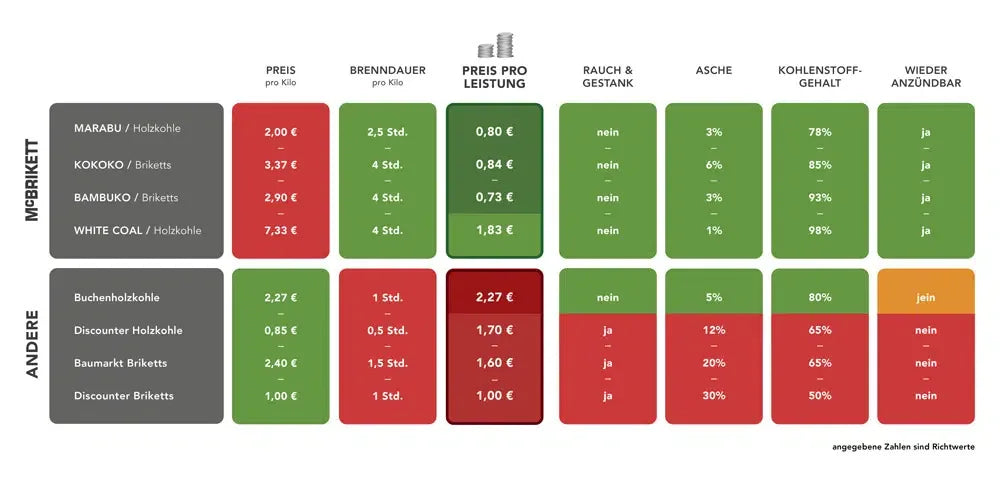
Do you think all charcoal is the same? The combination of high quality and sustainability makes our grill charcoal a unique promise to all grill fans and enthusiasts. Grilling becomes absolutely stress-free. The grill is always hot, you don't have to add more charcoal, everyone gets enough to eat, and there's no smoke or unpleasant smell. Nowhere else do you get more performance for your money.
This thesis surprises not only die-hard barbecue fans. At €3.37 per kilo, we are in some cases 10-15% above the large, well-known brands. But in terms of quality, we play in a different league.
The challenge is to convince people that despite a higher price per kilo, they get more performance per kilo.
With a burning time of 4 hours per kilo, the price per performance is significantly lower than that of the competition. Hardware store charcoal, at a price of €2.40 per kilo, only has a burning time of about 1.5 hours.
Our charcoal therefore costs only half as much per performance.
But we don't just have coconut charcoal. Our product range has been steadily expanded with additional products.
These include Marabu charcoal, White Coal, and bamboo charcoal. Kasper lovingly refers to bamboo charcoal as the "Ferrari among grill briquettes."
Marabu charcoal is grill charcoal made from upcycling. BAMBUKO bamboo charcoal impresses with its extremely high heat and a maximum ash content of 3%.
"Damn good and hot." A comparison that suggests a Ferrari sports car. Learn more about the smoke-free and environmentally friendly grill briquettes and how they are produced on a sustainable basis.
Do you think all charcoal is the same? The combination of high quality and sustainability makes our grill charcoal a unique promise to all grill fans and enthusiasts. Grilling becomes absolutely stress-free. The grill is always hot, you don't have to add more charcoal, everyone gets enough to eat, and there's no smoke or unpleasant smell. Nowhere else do you get more performance for your money.
This thesis surprises not only die-hard barbecue fans. At €3.37 per kilo, we are in some cases 10-15% above the large, well-known brands. But in terms of quality, we play in a different league.
The challenge is to convince people that despite a higher price per kilo, they get more performance per kilo.
With a burning time of 4 hours per kilo, the price per performance is significantly lower than that of the competition. Hardware store charcoal, at a price of €2.40 per kilo, only has a burning time of about 1.5 hours.
Our charcoal therefore costs only half as much per performance.